
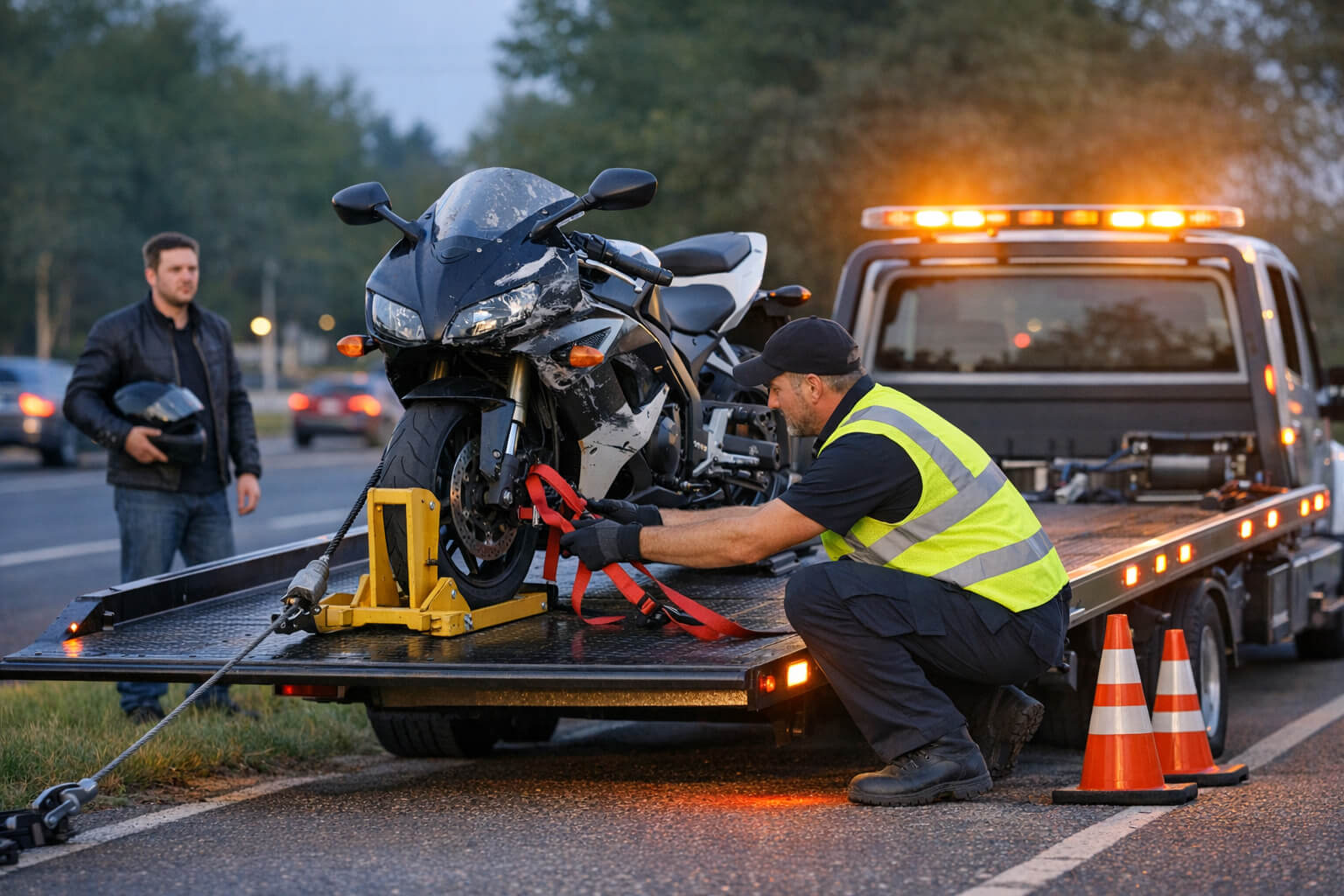
If you’ve just been in a motorcycle accident, moving the bike isn’t automatically the right next step. The safest move is usually to protect people first, reduce traffic risk, and document the scene, then decide whether the motorcycle can be moved a short distance or should be transported on a flatbed or motorcycle-capable trailer. When the bike is inoperable, leaking fluids, or the steering/suspension may be compromised, professional transport is often the least risky choice. If you’re in the Charlotte area and you need help moving a damaged motorcycle or ATV safely, Sunny Day Towing & Auto Transportation can be reached at (704) 504-7449.
First priorities at the scene (before you touch the bike)
In the first few minutes after a crash, the biggest hazards are traffic, injuries, and secondary collisions, not the bike’s cosmetics. If you can stand and move, get yourself out of the travel lane and to a safer spot where you can see oncoming traffic. If anyone is injured or traffic conditions are dangerous, call 911 and let EMS and law enforcement control the scene.
Visibility matters even in daylight. Drivers don’t expect a downed motorcycle in the road, and they may be looking at the incident instead of the lane. Use hazard lights if your bike still has power and you can activate them safely, and use reflective triangles or a high-visibility vest if you carry them. Avoid standing between the bike and moving traffic, and don’t crouch down in a lane to pick up parts.
Sometimes people feel pressured to “clear the road” immediately. If you can safely drag or roll the bike a few feet to a shoulder without putting yourself at risk, that can reduce the chance of a second crash. But if the bike is pinned, unstable, or leaking fuel, it’s often safer to step back and wait for help rather than trying to wrestle it out of the road.
Should you move the motorcycle at all?
Moving the bike can prevent it from being hit again, but it can also create new hazards and complicate insurance or injury claims if it’s done carelessly. The decision comes down to immediate safety, what the bike is doing (leaking, smoking, unstable), and whether you can move it without risking yourself.
Situations where you should not move it
Fuel leakage changes everything. If you smell strong gasoline, see fuel dripping, or notice a widening puddle, step away and keep ignition sources away from the area. Don’t attempt to start the bike and don’t drag it by the bars while fuel is spilling. Smoke, sparking, or melted wiring near the battery is also a reason to keep distance and wait for responders.
Physical instability is another red flag. If the front end looks twisted, the bars are jammed against the tank, a wheel won’t rotate, or the bike feels like it wants to topple unpredictably, forcing it to roll can cause more damage or cause you to fall into traffic.
If police are responding, it’s usually best not to move the bike until they’ve documented the scene unless it’s creating an immediate danger. Photos and a clear record of the bike’s resting position can matter later.
Situations where moving it a short distance makes sense
When the motorcycle is in an active lane, on a blind curve, or in a spot where other drivers can’t see it in time, moving it to a safer shoulder or nearby parking lot can reduce risk. In that situation, you’re not trying to “fix” anything. You’re trying to create distance from traffic.
Keep the move short and conservative. Roll it to the nearest safe location, then stop and reassess. If you’re alone and the bike is heavy or awkward, don’t strain yourself. A back injury or a fall is far worse than a scuffed fairing.
Quick damage check before any movement (60 to 120 seconds)
A fast scan can prevent you from rolling a bike with a dangerous leak or a locked wheel. You’re not diagnosing the whole motorcycle, just looking for the deal-breakers.
Look for fluid leaks
Check under the bike and around the tank area. Gasoline is usually obvious by smell and sheen. Oil will look slick and darker. Brake fluid can appear clear to light amber and may come from a damaged line or master cylinder area. If you see any active leak, assume the bike isn’t safe to start and should be transported rather than ridden.
Check wheels and controls for hazards
Look at the tires and rims for obvious deformation. Try rolling the bike a few inches if it’s stable and you’re out of traffic. If a wheel won’t rotate freely, don’t force it. Check the bars and levers. A bent brake lever can hold pressure on the brake, and a damaged throttle can stick in a way that makes riding unsafe.
Check for electrical or battery hazards
If the bike went down hard, wiring can be pinched or torn. If you see exposed wires, sparking, or damage around the battery area, avoid turning the key on repeatedly. Electrical issues can escalate quickly, especially if fuel is present.
Document the bike and the scene (helps with insurance and repairs)
Photos taken before anything is moved are some of the most valuable “repairs” you can do at the scene. They help insurance, they help the shop understand impact direction, and they help you remember details that get fuzzy after the adrenaline wears off.
Photos to take before it’s moved
Start with wide shots that show where the bike ended up relative to lanes, curbs, and traffic signals. Then take medium shots from all four sides, then close-ups of damage: bars, levers, mirrors, turn signals, exhaust, engine covers, foot controls, and wheels. If you can safely access them, photograph the license plate and any visible VIN label area.
Details people forget
Road debris, gouges in pavement, skid marks, and a trail of fluids can all matter. Take a few seconds to photograph broken pieces on the ground before you pick them up. If there are witnesses, get names and contact information, and write down the time, approximate location, and weather.
Keep damaged parts if it’s safe
Loose parts can help the shop identify what broke first and what might be missing. If it’s safe and you can do it without stepping into traffic, collect detached pieces and put them somewhere secure.
If the bike seems rideable, pause and think
A motorcycle can look “mostly fine” and still be unsafe to ride after a crash. A small hit can bend bars, knock the forks out of alignment, crack a wheel lip, or tweak a rotor, and those problems often show up under braking or at speed.
Fork alignment issues are a common example. The bike may roll, but the front wheel might not track straight, or the bars may be slightly off-center. Brakes can also be compromised without obvious leaks. A rotor can be warped, a caliper bracket can be damaged, or a brake line can be kinked. Tires can lose a bead or suffer sidewall damage after curb impact.
If you’re considering starting the bike, be cautious if it was on its side. Some motorcycles can be sensitive to oil pooling or fuel flooding after a tip-over. Even if it starts, that doesn’t mean it’s safe to ride. If anything feels uncertain about steering, braking, throttle return, or wheel tracking, transporting it is usually the smarter call.
Safe ways to move a damaged motorcycle (without making it worse)
When you do need to move the motorcycle, the goal is stability and control, not speed.
Pushing the bike safely
If the bike will roll and you’re in a safe area, pushing it can be safer than starting it. Keep it upright, walk on the side away from traffic when possible, and use the front brake gently to control speed. Avoid pushing downhill, and avoid sharp turns if the bars feel misaligned.
Whether to keep the ignition on depends on the bike and the situation. If you need the steering to unlock, you may need the key in. But if there’s any concern about electrical damage, keep it off and avoid repeated key cycling.
Moving it with help
Two people make most moves safer. One person can stabilize the bars and front end while the other supports the rear or manages the roll. Hold solid parts, not plastics, windscreens, mirrors, or turn signals. If the bike is heavy or stuck awkwardly, don’t try to “deadlift” it into a truck bed. That’s how people get hurt and bikes get dropped again.
What not to do
Avoid towing a motorcycle with a rope or strap behind a car. It’s unstable, it can cause a second crash, and it can damage the bike further. Also avoid improvising tie-downs to a bumper or hitch to “drag it home.” A damaged front end or locked wheel can turn that into a dangerous skid immediately.
Transport options after a crash (and why flatbeds are common)
A flatbed is often the safest option for a crash-damaged motorcycle because it keeps the bike stable and reduces the risk of tip-over during loading, transport, and unloading. A proper motorcycle trailer can also work well when it has a wheel chock and the right tie-down points.
“Properly secured” generally means the bike is stabilized upright, the front wheel is controlled, and straps are attached to strong points using soft ties where needed. Straps shouldn’t crush fairings or pull against delicate parts. The bike should not be leaning at an odd angle or bouncing freely when the truck moves.
Where the bike goes depends on your situation. Home makes sense if you’re waiting on an insurance adjuster or choosing a shop. A repair facility is ideal if you already know where it’s going. Storage yards can add fees and complications, so it’s worth thinking through the destination while you’re arranging transport.
Questions to ask before authorizing transport
You don’t need to interrogate anyone, but a few practical questions can prevent avoidable damage.
- Can you transport motorcycles or ATVs, and do you have the right equipment for it?
- How will the bike be secured, and where will straps attach?
- Is the transport insured if the bike is damaged during loading or transit?
- Can you drop it at the destination you want, and are there any access issues after hours?
These questions also help you gauge professionalism. Clear, straightforward answers are a good sign.
After the bike is transported: next steps
Once it’s in a safe place, resist the urge to wash it, disassemble it, or “tidy up” damage if you’re filing a claim. Photos of the condition as-delivered can matter. A professional inspection is also worthwhile, even if damage looks minor. Alignment, brakes, wheels, and steering components can be affected in ways that aren’t obvious in the driveway.
Keep a folder with your photos, any incident report number, witness information, and transport receipts. It makes the insurance and repair process smoother, and it reduces the chances of disputes later.
Summary
After a motorcycle accident, the safest approach is usually to secure the scene, check for injuries, watch for leaks or electrical hazards, document everything, and avoid riding if steering, brakes, or wheels could be compromised. Moving the bike a short distance can make sense when traffic risk is immediate, but a damaged motorcycle is often best handled with proper equipment and tie-downs to prevent further harm.
If you’re dealing with an inoperable motorcycle, trike, or ATV and need it moved safely to a shop or another location, Sunny Day Towing & Auto Transportation can help with motorcycle and ATV transportation. Save (704) 504-7449 for when you need professional assistance that protects both you and your bike.


